
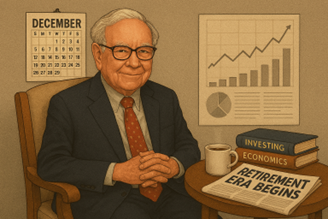
As the end of 2025 draws closer, so too does Warren Buffetts’ tenure as CEO of Berkshire Hathaway. I am sure as the days tick down to 31st December, Mr Buffett will enjoy a period of reflection. In a similar way, I find this a good time to re-evaluate our calls through the year, look at what worked well and decide whether we should continue to hold positions that haven’t quite realised; and doing so with some help from Mr Buffett himself.
“Opportunities come infrequently. When it rains gold, put out the bucket, not the thimble.”
Indeed, Gold has been a notable outperformer this year and we have played on this theme strongly. Coming into the year, our strategy portfolios had on average 4% physical gold exposure and 2% gold mining company exposure.
Gold has surged to record highs, driven by strategic central bank buying, especially from China, in response to geopolitical tensions and the freezing of Russian reserves. This comes at a time as many countries are in pursuit of de-dollarisation (the term linked with reducing exposure to dollar reserves). The buying has more recently been largely price-insensitive and strategic, but gold still keeps links to traditional drivers like real interest rates and the dollar.
What are we watching out for? Clearly, if China and other central banks were to stop or slow their purchases, this could trigger a pullback. For now, there is no clear catalyst for China to temper its buying. Additionally, both institutional and retail investors still have relatively low allocations to gold, and recent data has been showing a significant upturn in ETF (Exchanged-Traded Fund) inflows to gold related assets. As Bitcoin continues to be ever more correlated to a leveraged play on growth stocks, we see a real case that the yellow metal continues to be viewed as a leading hedge against geopolitical and currency risks. While we shouldn’t expect a similar level of returns to those seen this year, largely due to base effects, we do see continued strength ahead.
“If you aren’t willing to own a stock for 10 years, don’t even think about owning it for 10 minutes.”
UK bank shares have enjoyed a strong run this year, driven by a combination of resilient fundamentals and supportive macro conditions. This is evidenced by quarterly earnings reports where the banks have been highlighting improving net interest margins (the difference between what rate they pay interest on savings and what rate they receive on lending) and benign impairments. More recently, relief over the absence of a windfall tax and a stabilising gilt market provided a boost to sentiment.
Long term value ahead? Looking ahead, growth prospects remain compelling. The sector offers a combined dividend and buyback yield of high single digits, which compares favourably to gilts and inflation expectations. As rates gradually decline, banks could benefit from increased lending activity and lower funding costs, while their diversified business models—spanning retail, corporate, and wealth management—provide resilience against margin pressure. This has reinforced our confidence that UK lenders are well-positioned to navigate a “higher-for-longer” rate environment, even as the Bank of England begins to cut rates.
Separately, the FPC (Financial Policy Committee of the Bank of England) published their latest thoughts on UK bank capital requirements. Without drilling into all the details, the paper made it clear that banks’ capital requirements are being reduced for the first time since 2009. In addition, they also highlight that they would like them to remove large management ‘buffers’ in case of unforeseen events and operate closer to the regulatory requirements. While we don’t expect banks to reduce their capital ratios overnight, we do see them moving lower over time, which should help increase return on equity, and subsequently, provide more capital to support balance sheet growth or returns to shareholders.
In short, UK banks are evolving into steady, income-generating franchises, and with capital returns (both through dividends and share buybacks) set to remain generous, the sector looks well placed to deliver attractive total returns in 2026 and beyond.
“Don’t pass up something that’s attractive today because you think you will find something better tomorrow.”
The Japanese Yen has been notably weak over the last few years, trading over 40% below its purchasing-power-parity fair value against the dollar, according to the International Monetary Fund (against sterling the Yen is around 30% below fair value). This weakness has been driven by several factors: persistent low real interest rates (interest rates with inflation factored in), a long period of deflation, and Japan’s cautious approach to monetary policy normalisation. Political uncertainty and trade tensions with China have also weighed on sentiment.
So why buy Yen now? However, the outlook is improving. Japan is undergoing significant corporate reforms, increasing foreign ownership, and consolidating its corporate sector, which should boost profitability and attract capital inflows. The Bank of Japan is expected to gradually tighten policy (slowly increase borrowing costs) as inflation stabilises, and Japan’s strong external position (current account surplus and net international investment position) provides a cushion. As the Federal Reserve in the US and Bank of England have the potential to cut rates more aggressively than markets expect in 2026, this should support Yen appreciation.
“The stock market is a device for transferring money from the impatient to the patient.”
Value stocks have lagged growth stocks for the last few years, particularly in the US, where the S&P 500 has been pushed higher primarily by a narrow cohort of AI-related technology companies. Growth stocks represent companies expected to increase earnings at an above-average rate, often reinvesting profits rather than paying dividends. While value stocks are those considered undervalued relative to their fundamentals, typically offering stable returns and higher dividend yields. However, we feel that the market is at a turning point.
Why are we holding on? One empirical way of looking at this is by examining the gap in quality between cheap and expensive stocks in the US, based on several quality-based metric scores such as return on equity, profitability, and earnings growth. In most scenarios, we find that growth stocks provide a more attractive forward-looking return, but today we find that the score difference sits in the upper quartile, which, based on past market cycles, usually means a period of potential outperformance for value stocks. Couple that with the fact US growth stocks, particularly those in the technology sector, trade at historically high price levels relative to their earnings, we feel justified in continuing to hold exposure to value stocks.
To Mr Buffett – enjoy your retirement. And to our clients and professional connections, best wishes for 2026 from all at Charlotte Square.
Liam Goodbrand, Investment Manager
17 December 2025
Keep Informed
Sign up to our View from the Square.